What spring freeze risk really means for the Colorado peach crop
2-Minute Read
Spring in Palisade always comes with two things: hope and nerves.
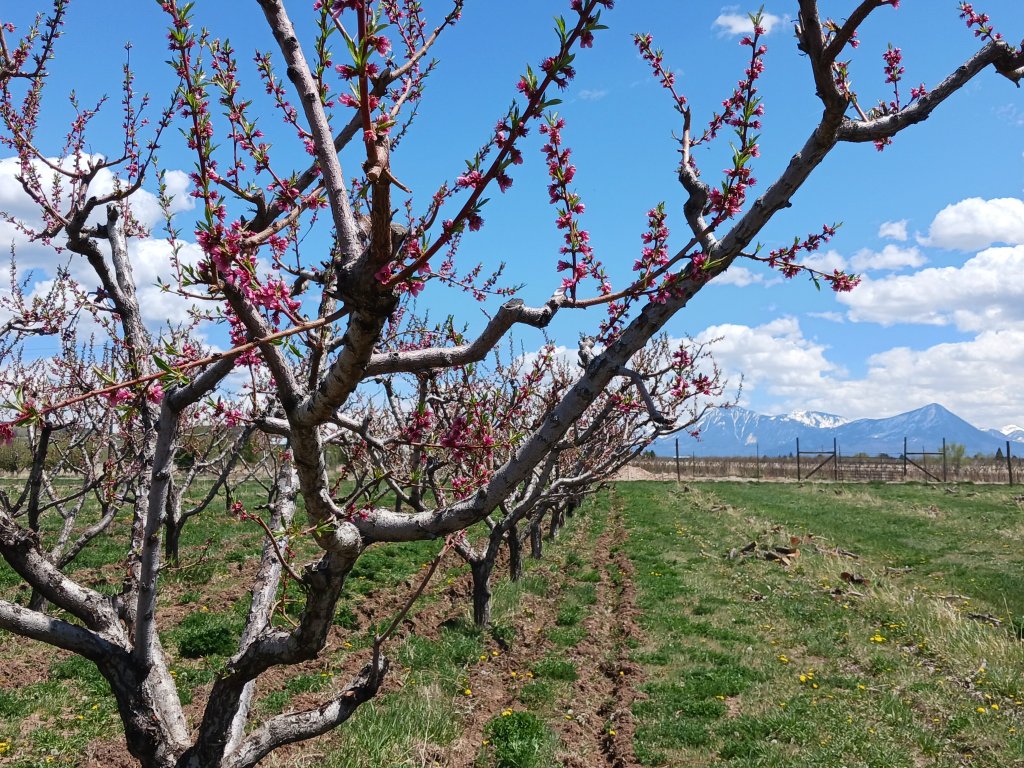
Hope, because the trees wake up, the valley starts to bloom, and another peach season begins to feel real.
Nerves, because every grower knows that one cold night at the wrong time can change the story fast.
This year, a lot of people are asking the same question:
Will there be Palisade peaches this year?
The short answer is yes, probably. The better question is how big the crop will be. Based on what we know right now, 2026 looks more like a year with a real crop and some risk of spotty or moderate losses than a repeat of the devastating 2020 freeze disaster. Grand Valley orchards are running unusually early this year, which increases exposure to spring frost, but the public reporting so far does not point to a valley-wide collapse.
8-Minute Read
What’s the short answer?
Yes, we still expect Palisade peaches this year. The bigger unknown is whether the crop ends up normal-sized, a little lighter, or meaningfully reduced.
Colorado’s peach crop is naturally variable. Over the last two decades, most years have still produced a meaningful crop, usually somewhere in a broad range of roughly 10,000 to 14,000 tons, with stronger years above that and one clear disaster year in 2020. That historical pattern matters because it reminds us that a scary spring freeze does not automatically mean there will be no peaches.
“A bad-looking week in April is not automatically another 2020.”
Why spring cold weather matters so much for peaches
Peach trees are tougher than they look in winter, but much more fragile once they start growing.
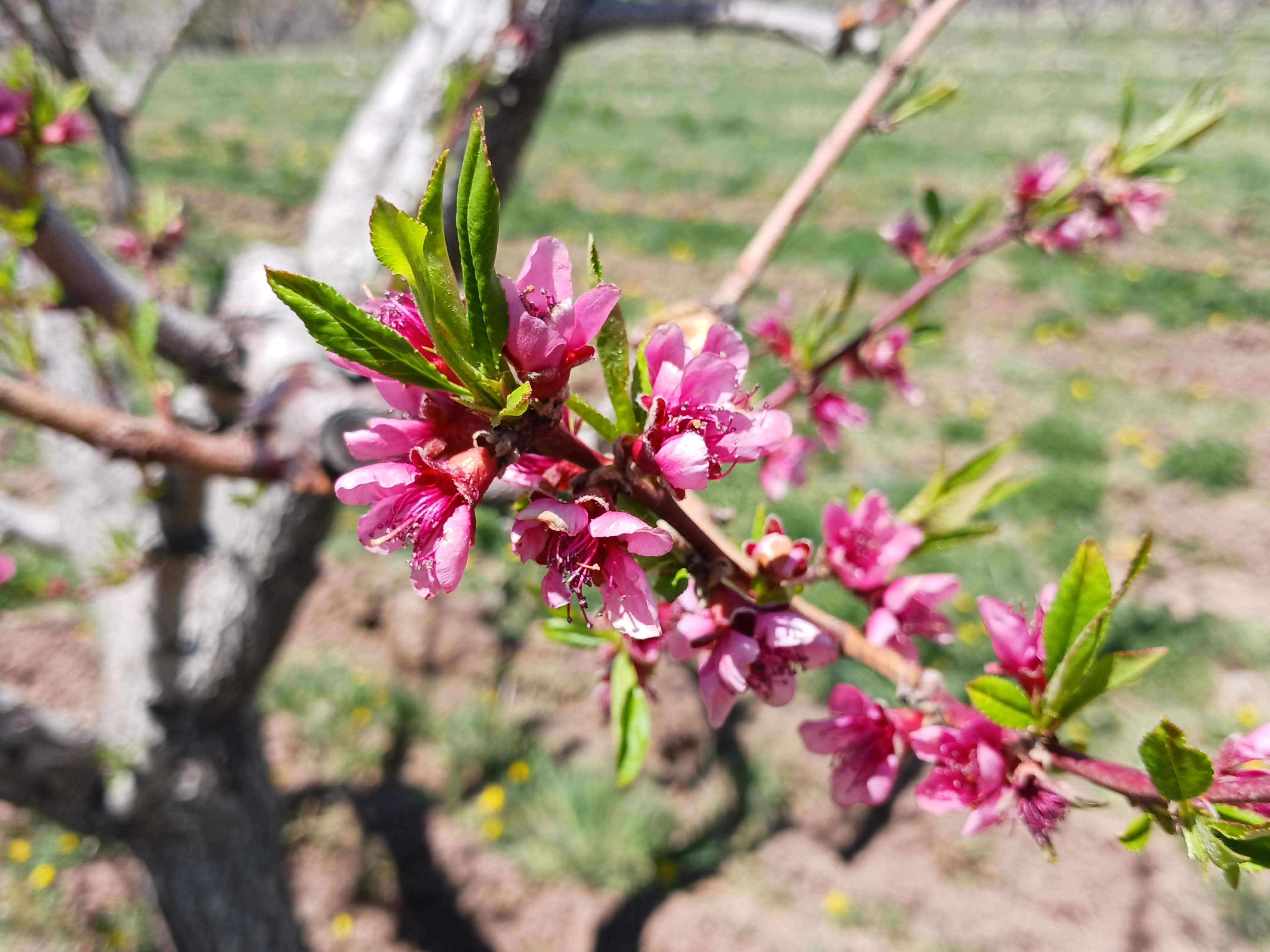
While the trees are dormant, they can tolerate a lot more cold. But once buds swell, blossoms open, and tiny fruit begins to form, the crop becomes much more vulnerable. That is why growers do not just ask, “How cold will it get?” They ask: How cold, for how long, and at what stage of development?
That is also why 2026 has people paying such close attention. Local reporting this spring said Grand Valley orchards were running about three weeks ahead of normal bloom timing, which means the crop is exposed earlier during frost season than growers would like.
The latest reporting on CSU’s Western Slope peach work adds another reason for caution. The Colorado Sun reported that once peaches are at bloom, temperatures around 24°F will often kill all or most buds, while 27°F to 28°F can still cause partial losses depending on orchard conditions and protection.
What happened in early April 2026?
Early April brought exactly the kind of weather that makes peach growers lose sleep.
After a warm winter and an early start to bloom, a freeze threat arrived while orchards were already more advanced than normal. Growers across the region prepared with wind machines and other frost-protection measures. Public reporting at the time focused on how exposed the crop was and how much depended on the exact temperature, orchard location, wind, and timing of bloom.
That is an important point for customers to understand: freeze outcomes are rarely all-or-nothing. One orchard can come through relatively well while another, just a little lower or colder, can take a harder hit.
And because fruit damage often takes time to show up, the full picture is usually not clear the next morning. Growers often need days or even weeks before they can judge fruit set and real crop potential. CPR’s 2014 Palisade freeze coverage made exactly that point after a cold event that looked scary but ultimately did not wipe out the crop.
What does the forecast look like now?
As of now, the 10-day Palisade forecast looks mostly manageable overall, but not entirely comfortable. Most lows are in the upper 30s to upper 40s, but Friday, April 17 currently stands out with a forecast low of 25°F, which is cold enough to matter if orchard temperatures verify that low in bloom-stage peaches.
That does not automatically mean major losses. Town forecasts and orchard-floor temperatures are not always the same, and wind, moisture, cloud cover, inversion conditions, and active frost protection can all influence outcomes. But it does mean the frost season is not over yet, and the crop is not fully “safe” just because one freeze event has already passed. That is an inference from the weather pattern and the bloom-stage thresholds described in current reporting.
“In peach country, a few degrees can make a very big difference.”
What history says about Colorado peach crops
The best way to understand a year like 2026 is to zoom out.
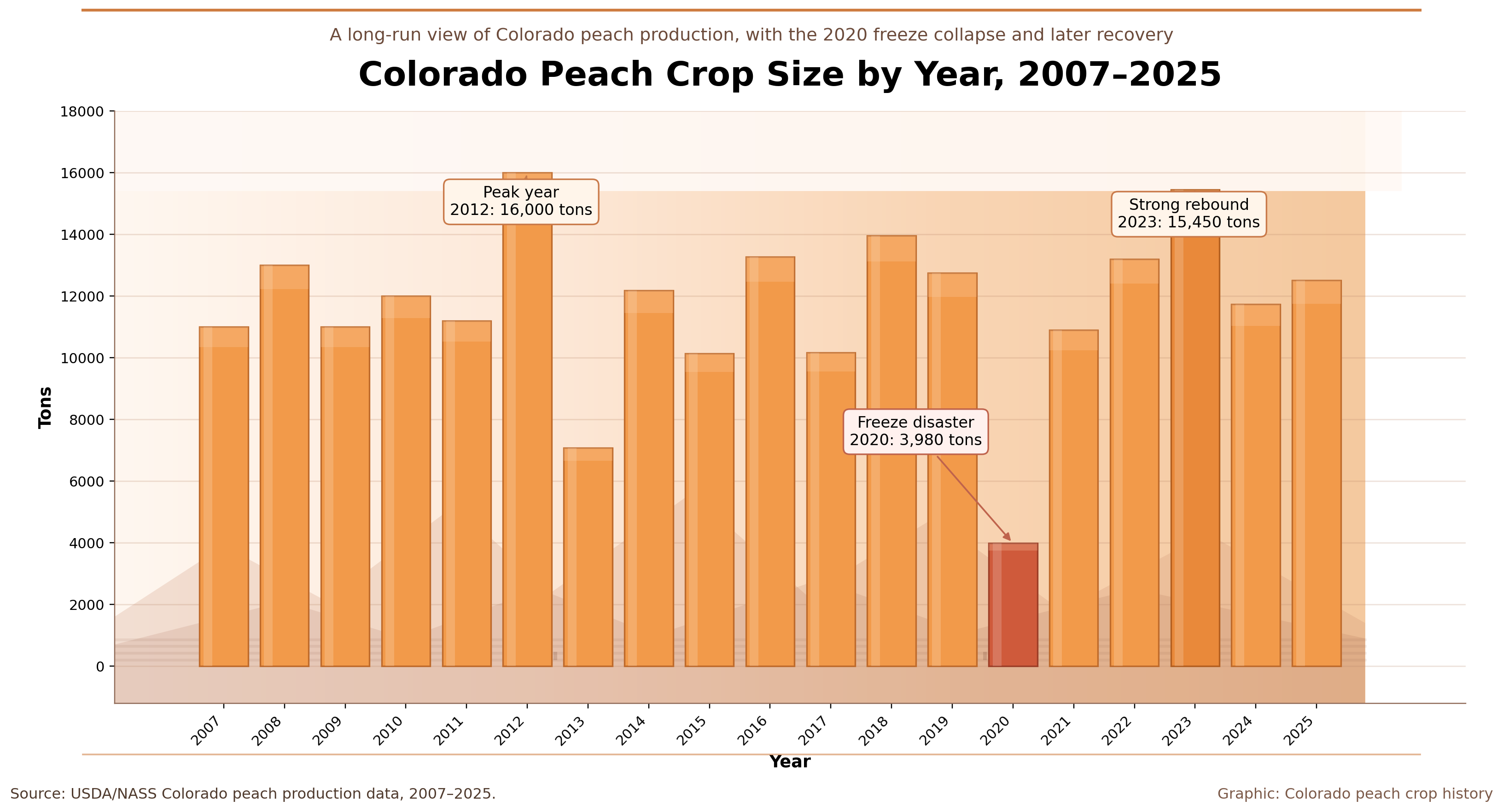
USDA/NASS data show that Colorado peaches are usually a meaningful but variable crop. Most years are not disasters. Some are excellent. Some are lighter. A few years bring serious freeze damage. And one year in recent memory, 2020, was a true collapse.
Selected Colorado peach crop volumes from USDA
2007: 11,000 tons utilized
2008: 13,000 tons utilized
2009: 11,000 tons utilized
2010: 12,000 tons utilized
2011: 11,200 tons utilized
2012: 16,000 tons utilized
2013: 7,080 tons utilized
2014: 12,180 tons utilized
2015: 10,140 tons utilized
2016: 13,260 tons utilized
2017: 10,160 tons utilized
2018: 13,960 tons utilized
2019: 12,740 tons utilized
2020: 3,980 tons utilized
2021: 10,890 tons utilized
2022: 13,190 tons utilized
2023: 15,450 tons utilized
2024: 11,730 tons utilized
2025: 12,500 tons
If you scan that list, the pattern is pretty clear:
Most years still produce a real crop.
Colorado often lands somewhere in the broad 10,000 to 14,000 ton range.
Strong years can move into the mid-15,000s.
When a severe freeze hits at the wrong stage, the crop can fall off a cliff.
The year everyone remembers: 2020
If you want to understand why spring freezes make people nervous, look at 2020.
That year, Colorado officials requested a USDA disaster declaration after a severe freeze event. Public reporting and the state’s own announcement described temperatures dropping into the teens in parts of the Western Slope, with potential losses severe enough to devastate the peach crop in affected areas. USDA’s final number for Colorado peaches that season was just 3,980 utilized tons, far below normal.
That is the benchmark for a true peach disaster year in modern Colorado history.
And that is why it is important not to casually throw around the phrase “crop failure.” Real disaster years leave a very obvious trail: emergency language, widespread reports of heavy losses, and final crop numbers far outside the normal range.
Not every freeze scare becomes a disaster
This is the other half of the story, and it matters just as much.
Colorado has had several years where growers were worried, wind machines were running, the crop was exposed, and the final outcome still turned out far better than people feared.
2014: freeze scare, normal crop
CPR reported that Palisade growers turned on wind machines at 28°F, noted that moisture in the air may have helped insulate the fruit, and one grower said, “Overall I would say that we survived it.” USDA’s final number that year was 12,180 tons, right in the normal range.
2022: real frost, still a good year
USDA’s final number for 2022 was 13,190 tons utilized, and local TV reporting that spring quoted Talbott saying the crop still looked better than 80% and maybe 90% of full crop potential after a frost event. That is a good example of a year where freeze risk was real, but the crop still finished strong.
2024: meaningful down year, not a wipeout
USDA reported Colorado’s 2024 utilized peach production at 11,730 tons, down 24% from 2023. That is not what a bumper crop looks like, but it is also nowhere near a disaster year. It is probably the best recent example of what a lighter but still meaningful Palisade peach season can look like.
So what does 2026 look like right now?
At this point, 2026 does not look most like 2020.
It looks more like a year in the 2014 / 2022 / 2024 family:
real freeze concern
an early and exposed bloom
growers actively using frost protection
no official evidence yet of a valley-wide collapse
That does not mean everything is perfect. It means the most evidence-based comparison right now is a year with a real crop and some risk of spotty or moderate losses, not a confirmed wipeout.
Our current working estimate, based on historical analog years rather than an official forecast, is that 2026 appears more likely to finish as a meaningful crop year than a disaster year. If the season follows the path of similar years, it would likely end up closer to the kind of crop Colorado saw in 2014, 2022, 2024, or 2025 than to the collapse of 2020. That is an inference from the historical data and current reporting, not a USDA forecast.
“Right now, 2026 looks more like a reduced or mixed crop year than a total loss year.”
What could still change the story?
There are still several things that could move the outlook down:
more hard-freeze nights before the danger window closes
colder orchard-floor temperatures in low pockets than town forecasts suggest
longer-duration cold under clear, calm conditions
bud checks or fruit set showing more damage than growers hoped for
In other words, the remaining frost season still matters.
A little peach history: growers have been fighting frost for more than a century
One of the interesting things about Palisade peach history is that modern growers are still dealing with some of the same spring problems orchardists faced more than 100 years ago.
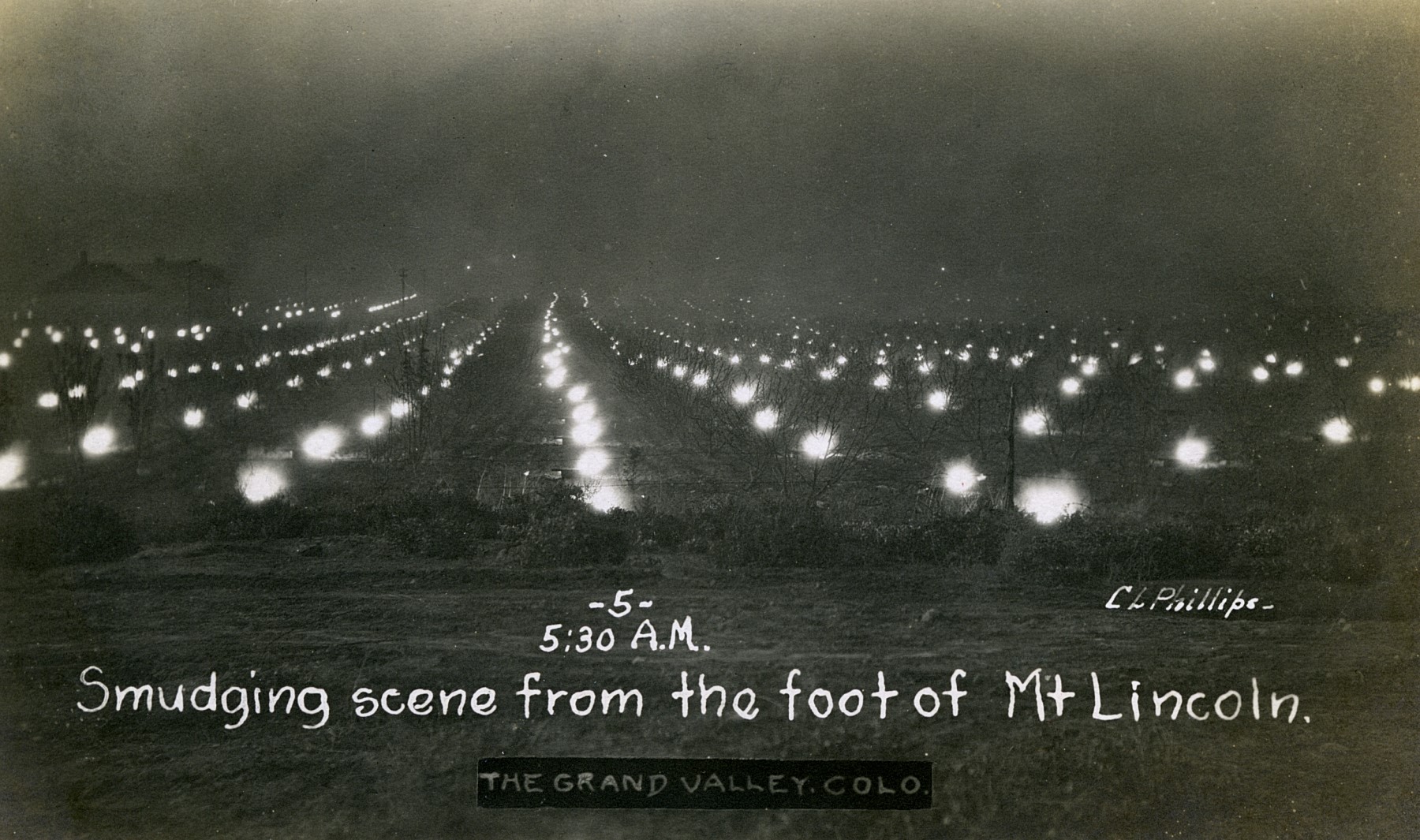
Mesa County Libraries’ local history work describes Palisade’s famous “million dollar wind” and explains how early growers also used smudge pots, orchard heaters that helped protect fruit from frost. By the spring of 1908, the article says, thousands of smudge pots were in use and “great clouds of smoke” hung over the valley.
We are reminded that peach growers in this valley have been staying up all night, watching temperatures, and trying to outsmart spring weather for a very long time.
The more honest uncertainty is not whether there will be peaches at all, but how large the crop will end up being.
Right now, this does not look like a confirmed repeat of 2020. It looks more like a year where the crop may still be very real, but where final size could range from solid to somewhat reduced depending on what happens with the rest of the frost season.
For peach lovers, that means there is still good reason to be hopeful.
For growers, it means the next cold night still matters.
Sources & Notes:
Note: This article is based on publicly available reporting, USDA crop statistics, and current weather information available at the time of writing. The 2026 crop discussion above is not an official crop forecast. It is a historical comparison using the best publicly available information.



Leave a comment